
Against Subjectivism & Toward Analytical Decision-Making
I. Introduction
It is common knowledge among students of communism that Chairman Mao struggled against a variety of incorrect lines, both right and “left,” in the period leading up to and during China’s protracted people’s war. But one thing that separates Mao from lesser Marxists is his continual emphasis on not just struggling against the incorrect lines themselves, but the larger methods of thought and study that produced them. He knew that it is not enough to merely treat the symptoms; one must eradicate the disease that causes them, lest similar symptoms keep returning. The deadliest disease that Mao contended with during this period was that of subjectivism.
Broadly speaking, subjectivism is the malady of viewing political questions through a narrow personal lens, of analyzing things in a one-sided manner without taking all of their aspects into account, of failing to observe the correct relationships between the lessons of Marxist theory and one’s particular conditions — between rational and perceptual knowledge. Mao identified subjectivism as one of the principal threats to the Chinese Communist Party because it can manifest itself in such a wide array of specific and harmful errors, noting that if left unchecked, “subjective analysis of a political situation will inevitably result either in opportunism or in putschism,” “causing great harm to the analysis of the political situation and the guidance of the work.”¹ In Rectifying the Party’s Style of Work, Mao delineates symmetrical and inverse forms of subjectivism which “each originate from an opposite pole”: empiricism & dogmatism.
Mao characterizes empiricism as the phenomenon in which a person “mistake[s] their partial experience for universal truth.”² It is exemplified in comrades who “restrict themselves to their own fragmentary experience and do not understand the importance of theory for revolutionary practice, or see the revolution as a whole, but [work] blindly though industriously.”³ In other words, empiricism signifies an overemphasis on data at the expense of theory, i.e. focusing on particular conditions without respect for Marxist theory and using appeals to these conditions (“it’s different now!” “it’s different here!”) to preach revisionism. Empiricist tendencies are often found in those who have practical experience, but have not been exposed to much Marxist theory or history.
Dogmatism, on the other hand, can be summed up as the idea that “whatever is written in a book is right.”⁴ Dogmatists make habit of “denying the truth that ‘Marxism is not a dogma but a guide to action’ and overawing people with words and phrases from Marxist works, torn out of context.”⁵ They frequently “confine themselves to ready-made phrases in books.”⁶ In other words, a dogmatist relies heavily on theory, but without incorporating the necessary specific data that informs the application of said theory. This trait is naturally found in petit-bourgeois Marxists whose book worship outpaces their practical experience.
In 1937 with On Practice and again in 1942 with Rectifying the Party’s Style of Work, Mao identified dogmatism as the bigger threat in the Party. Which of the two is more prevalent in the US communist movement today depends largely on how tightly one defines “communist movement.”
Revisionists of many different flavors turn empiricism into a virtue, cherishing eclecticism (which is strongly correlated with empiricism, though not 1:1) and arguing that important Marxist doctrines are inapplicable today due to their assessment of “material conditions” (what conditions they are referring to is rarely specified); they ignore lessons from the international communist movement’s history in favor of reinventing the wheel in ways that almost always remove class struggle from its central place in communist practice.
On the other hand, those of us who are guided by a defined and developed ideology often lapse into dogmatism, converting our ideology into politics without enough consideration of current and local conditions. Bookworshippers will copy and paste tactics from past revolutions rather than properly ascertaining the universal behind those actions and creatively applying that universal to their own specific; Mao describes this common type of dogmatism as “uncritical transplantation or copying from the ancients and the foreigners.”⁷ Dogmato-revisionism is unfortunately alive and well among both “orthodox” Marxist-Leninists and Maoists (the word revisionism is infrequently applied to dogmatic lines that seem “left,” but Mao states plainly that “dogmatic ‘Marxism’ is not Marxism, it is anti-Marxism”⁸).
A common source — and therefore manifestation — of subjectivism is activists replacing dialectical Marxist analysis with aphorisms & platitudes, both in their attempts at line struggle and in their internal reasoning. This can take the form of an out-of-context appeal to a specific text (such as when revisionists invoke Lenin’s “Left-Wing Communism” to defend reactionary electoral projects), to a general Marxist platitude (such as using “it is right to rebel!” to justify whichever line seems more “left”), or to a piece of an organization’s internal conventional wisdom (such as Marcyites repeatedly saying “meet people where they’re at” to justify right-opportunism).
Mao suggests that the primary methods for combating subjectivism are to “(1) teach Party members to apply the Marxist-Leninist method in analyzing a political situation and appraising the class forces, instead of making a subjective analysis and appraisal; [and] (2) direct the attention of Party members to social and economic investigation and study, so as to determine the tactics of struggle and methods of work, and help comrades to understand that without investigation of actual conditions they will fall into the pit of fantasy and putschism.”⁹ How can we specify and expand upon this advice in order to apply it in our daily political work?
Part of combating subjectivism requires approaching organizational questions in a truly scientific manner. Many Marxist classics tackle this topic implicitly, from Mao’s On Practice and On Contradiction, to Engels’ Anti-Dühring, to Lenin’s Materialism and Empiro-Criticism, and their insights are invaluable to developing a scientific outlook. However, to make these lessons concrete and apply them to all of our decisions, it is helpful to distill this broad scientific outlook further, into an explicit form specific to the decision-making process itself. Among other things, this involves analyzing the question at hand in all its aspects, including a systematic appraisal of all pertinent factors. When judging proposed courses of action, we must analyze them at both micro and macro levels, assess potential good and bad outcomes in a probabilistic manner, and always account for opportunity cost — the cost of resources used in a given action (time, energy, money, good will of mass contacts) converted into the gains they could represent if devoted to another potential action.
Of course, Maoism gives us a particularly powerful tool in the struggle against subjectivism and all types of deviation: the mass line method of communist leadership. However, a great deal of skill and nuance is required in order to practice the mass line optimally. Both “left” (commandist) and right (“bourgeois-populist”) errors are possible in both conception and application of the mass line. This specific terminology is taken from Scott Harrison’s book, The Mass Line and the American Revolutionary Movement, but the concept is a general one.
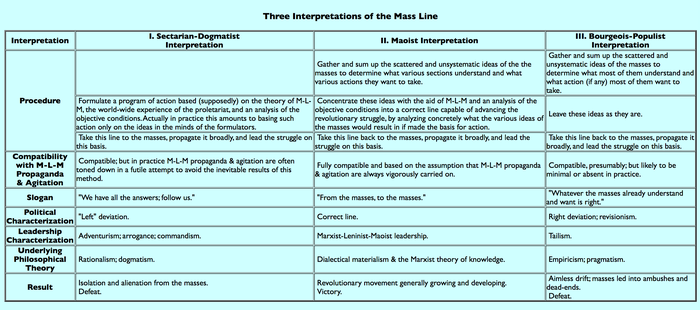
For a better view of the above table, see bottom of
Harrison associates commandist deviations in the mass line with dogmatism and left-opportunism, and “bourgeois-populist” right deviations in the mass line with empiricism and right-opportunism. These correlations certainly exist, but are far from one-to-one. Especially in the US, where right-opportunism is ubiquitous, we see plenty of right-commandism and right-dogmatism, such as in various (crypto-)Trotskyist groups.
While “how do we conceptualize and apply the mass line?” is an impossible question to succinctly address, we can focus on concrete questions like “what variables should be considered at each decision point?” and “through what methods and to what ends are we considering these variables?”, which primarily appear in the “processing” step of the mass line, when activists are deciding how to sharpen and return advanced ideas to the masses in the form of slogans and calls to action.
Rather than taking a stance on any particular line struggle, this is a supplementary document intended to give readers a taste of how to approach organizational questions in an analytical manner. It hopes to provide analytical tools to transcend simple aphoristic thinking, which — when combined with social investigation and a correct ideological orientation — can combat the subjectivism that underlies so many errors.
The body of this document will contain three sections: a taxonomy which divides relevant variables into four categories that must each be accounted for; a discussion of goal and campaign selection; and finally, a brief step-by-step procedure for making individual decisions at either the strategic level (expressed here as choice of campaigns and programs) or the tactical level (specific actions undertaken within a campaign or program).
II. The Four Quadrants of Relevant Variables
One of the most important aspects of proper decision-making is giving appropriate credence to all relevant variables in your decision-making process. In the Marxist sphere, the variables we take into account here are often referred to as conditions, or colloquially as factors. We will group these variables based on two criteria: whether they lie outside the organization (external) or within it (internal), and whether they inform us on objective material factors or on people’s subjective ideas. This creates four distinct “quadrants” that variables can fall into: external objective, external subjective, internal objective, and internal subjective.
This quadrant framework allows us to make potentially useful generalizations about the variables in a given quadrant, and perhaps more importantly, provides an exhaustive checklist to ensure all relevant factors are accounted for in the decision-making process.
External objective
When people use the phrase “material conditions,” they are generally referring to variables in the external objective quadrant. External objective conditions are quantifiable characteristics of a certain time and place that serve as the building blocks for class analysis — such as how capitalism is structured within a specific locale, how plentiful various classes are & how their forces are arranged, and what life is like for the masses on a quantitative level. What makes these factors objective is that they are mostly bereft of subjective personal analysis. Collected data has a “factual” character and often takes the form of numbers, percentages, cited laws, etc. Some key external objective variables include:
- In what proportion do members of the various classes exist, and how do these classes economically interact?
- What are the biggest industries (specific employers, general concentration & makeup of labor)?
- Who are the biggest individual class enemies of the potentially revolutionary classes (specific employers, landlords, politicians, etc.)?
- In what proportion do members of various nations exist, and how do they interact?
- What are the specific institutions of bourgeois class warfare or national oppression?
- Institutions like police & private security forces obviously come to mind, but what role do institutions like churches, appendages of the NGO complex (non-profits, Community Development Corporations, etc.) or reactionary trade unions play as well?
- Who is currently fighting these enemies, using what methods?
- What neighborhoods and industries contain the largest concentration of the masses? In what neighborhoods and industries is exploitation and oppression most extreme, or the conditions the worst? How is this changing over time?
- What other ways are the masses exploited other than surplus value extraction (rent, particular taxes, etc.) and what factors are affecting the dynamics of exploitation (gentrification, municipal & state government policies, etc.)?
Failure to properly study and account for external objective variables in the decision-making process produces instant dogmatism that can manifest in either right or “left” opportunism, depending on one’s subjective proclivities. This often leads to an organization stagnating or even liquidating, as it finds itself unable to correctly choose fronts of struggle, let alone specific tactics.
External subjective
External subjective conditions are the ideas of the masses. Much like external objective factors being the starting point for class analysis, external subjective factors are the starting point for the mass line; they comprise the data that must be gathered, processed, and returned to the masses in the form of slogans and calls to action. Mao illustrates this using the metaphor of a factory transforming raw materials into finished products:
All the raw material comes from the workers and peasants and from the localities. The Central Committee of the Chinese Communist Party can be likened to a processing factory, which uses raw material to turn out products. The finished products must be good, or otherwise mistakes are made. Knowledge comes from the masses.
Mao teaches that correct ideas come from social practice, and the masses as a whole provide the largest pool of social practice to which activists have access. Of course, not all of the masses’ ideas are correct; the masses are not a monolithic entity in any respect, but a sea of individuals — and every individual on earth possesses both correct and incorrect ideas. Failure to realize this will lead to a rightist “populist” conception and practice of the mass line, which is why ideas and individuals are generally categorized as either advanced, intermediate, or backward. But the huge pool of experience that the masses possess in the aggregate is one reason Mao states that “the masses are the real heroes, while we ourselves are often childish and ignorant, and without this understanding, it is impossible to acquire even the most rudimentary knowledge.”10
Examples of external subjective variables include:
- What aspects of life do people most want changed? In what spheres do they face the most unbearable exploitation, oppression, or abuse? What subsections of the population do they feel are being hit hardest?
- Who do they view as their main or most hated class enemies? Which enemies seem most vulnerable, and what are their specific vulnerabilities? Which class enemies do they view as unassailable? What other potential class enemies or societal institutions are in cahoots with these main or particularly vulnerable enemies?
- Who do they view as their allies in fighting these enemies? Of the people or institutions viewed as complicit, who do they think could potentially be won over?
- Beyond just class enemies, what other sources of their problems do they identify?
- What do they view as effective solutions to their problems, both in general and for a specific problem? What do they view as ineffective, at both the strategic and tactical levels? What unintended consequences do they think might arise from a particular campaign or tactic?
- Have they heard of your organization? What is their opinion of it and its individual members?
Social investigation, which is how activists ascertain these external subjective conditions, is an interpersonal skill with multiple aspects, each of which must be honed consciously and continuously. Among other things, activists must learn to ask the right questions, to extract the largest amount of relevant information from each conversation. They must be skilled at interpreting the answers they receive, which will come in a variety of forms and phrasings; it is unacceptable to miss valuable information because it was not phrased in a sufficiently Marxist manner. They must be conscious of their conversational tone and mindset: approach the masses as equals, and neither talk down to them nor put them on a pedestal, allowing learning and teaching to coexist in the same interaction.
These skills will not be sufficiently developed by mere repetition, but must be improved by intentional practice. Practice is made intentional by focusing on and interrogating one’s process during and after the practice itself. For example, when social investigation is done in groups, criticism/self-criticism sessions should be held regarding the activists’ performance in that investigatory session.
The more people an organization talks to and the more ideas it collects, the clearer its view of these external subjective conditions will be. As such, it is imperative to make social investigation and class analysis a systematic and intentional process. Whether a proposed action results in further relevant data collection must always be considered in evaluating said proposal. That is to say, whenever possible, tactics should be employed that put activists in contact with the masses and allow for bilateral exchange of ideas; emphasizing this principle when making decisions allows for better decisions to be made in the future.
Failure to properly take external subjective variables into account leads to a “left” commandist conception and practice of the mass line, and eventual isolation from the masses. It also results in a lack of creativity in slogans and actions, as the masses are the largest source of creative ideas for the communist movement.
Internal objective
Internal objective variables measure the organization’s resources and ability to complete various tasks. They determine the type, breadth, and depth of political work that can be undertaken at a given time; they especially must be considered when prioritizing given goals and projects. Costs, which must be taken into consideration when evaluating any proposal, are most often measured in quantitative units of internal objective factors — and the concept of opportunity cost dictates that, because we have finite internal objective resources, the gains from any potential use thereof must be weighed against potential gains from using them in a different manner. Examples of internal objective variables include:
- How many members does the organization have, and how many mass contacts does it have who are reliable and willing to do meaningful work? How much time and energy do these people have to devote?
- How much money does the organization have access to?
- What supplies does it have on hand (anything from printers to rifles)? What venues does it have access to for holding events, and where are they? Even having a porch or backyard in the right neighborhood can be a valuable resource.
- What concrete, specialized skills do members and reliable mass contacts possess (graphic design? electrical engineering? martial arts? carpentry? hacking?)?
Failure to properly take internal objectives variables into account leads to being either too ambitious or too conservative in the amount of work attempted at a given time; either work will go uncompleted or half-assed, or members and mass contacts will be underutilized, which may cause them to drift away from the organization. These costly errors can have downstream effects such as causing the organization to draw erroneous “lessons” from a failure, because a confounding variable has been introduced. For example, one might falsely attribute a failure to an error in the political line rather than in methods of work (n.b. on the other hand, awareness of this confounding variable can be used to defend incorrect political lines when both the line and methods were in error).
Internal objective variables are currently undervalued throughout the self-proclaimed communist movement, among empiricists and dogmatists alike. Idealistically asking “What would a communist party do?” is different from asking what your group can accomplish or should focus on at each stage of its development, precisely because your group is not yet a communist party. Ignoring this discrepancy only serves to perpetuate it.
Internal subjective
Internal subjective variables measure the ideas of the organization’s formal members, and their ideological advancement in different areas. Much like external subjective variables, they are important for choosing the path forward; the main differences are that they come into play during the “processing” step of the mass line rather than at the beginning, and represent a smaller sample size of social practice. They include the internal equivalent of each external subjective variable, as well as ideas on more esoteric ideological questions, and “soft skills” such as time management or social aptitude. They reveal the areas in which the organization or its specific members must improve (both ideologically and practically), and the organization or its specific members’ ability to lead the masses in class struggle at a given time.
The importance of internal subjective variables is especially evident when forming a pre-party organization, which requires a strong core of reliable, multi-faceted, and politically advanced comrades. This is not the time to relax on prerequisites in favor of social harmony or inclusion. Only after time and experience can an organization (confident in itself and its day-to-day operations) start to expand; the beginning must always be rooted in absolute consolidation.
On one hand, it is easier to discern internal subjective factors than external subjective factors, because they do not require the same kind of social investigation; after all, your organization’s members are right there. On the other hand, it is exceedingly difficult to assess the veracity of an organization’s own ideas, as well as the level of “soft skills” members possess, because of the huge amount of bias inherent to this type of self-evaluation. As such, empirical testing of these ideas through class struggle should always be emphasized, and considered as a potential positive outcome when evaluating any proposal. They must also be continuously checked against data gained from investigation of both external objective and external subjective conditions, and updated accordingly. Many organizations’ political lines or even entire internal cultures cannot reckon with the simple fact that Everyone Thinks They’re Correct.
It seems odd to discuss the consequences of not taking into account one’s own ideas, but identifying & understanding one’s own biases is something one should always be mindful of, in any organizational sphere. An important skill in applying the mass line is finding a balance between the masses’ ideas and the organization’s. Overemphasis on the masses’ ideas leads to rightist “populist” conceptions and practice of the mass line (and usually empiricism), while overemphasis on the organization’s own ideas leads to “left” commandist conceptions and practice of it (and usually dogmatism).
However, it is not a matter of finding an “equal” balance between the two. The masses’ ideas are generally primary, but the appropriate ratio changes based on several meta-variables, such as the type of decision being made, the sample size of the masses’ ideas gathered, and the amount of testing the organization’s ideas have had in the crucible of class struggle. This last one is especially notable. While the masses’ ideas are always the lifeblood of the communist movement, a steeled communist party in the midst of people’s war, for example, needs comparatively less guidance from the masses than does an upstart organization of activists getting its feet wet — as the former has already internalized more of the masses’ wisdom by practicing the three withs¹¹ for a long time, and has had its subjective ideas tested against reality via class struggle. Leadership is forged in the process of extensive (external) class struggle and (internal) two-line struggle, and the way in which communists utilize the mass line method of leadership (as well as the way an organization’s internal leadership interacts with its rank and file) at a given time should reflect this fact. This is an often overlooked logical corollary to the concept of jefatura.
The “soft skills” internal subjective factors are also difficult but important to evaluate. The primary methods for evaluating them are through empirical results of tasks and initiatives, criticism/self-criticism sessions within the organization, and asking for criticism from mass contacts. Failure to consider this subset of internal subjective variables can lead to sloppy methods of work, poorly completed tasks, and frustration from members whose skills are not being utilized appropriately. This can cause similar downstream effects to failures in analyzing variables in the internal objective quadrant.
In order to hone political skill and calibrate our internal subjective compass, organizations must eliminate the division between mental and menial work. Because of the concentric nature of layers of interaction with the masses, there will necessarily be contacts involved in certain tasks or at certain events who are not involved in ideological or political planning, but it is our job to engage and develop people into leaders as much as possible. Another aspect of this concentricity is there should be no ideological or political leaders who are divorced from mass work. Correct ideas come from social practice, and communists are forged in class struggle.
If you’re looking, you can see attention to variables from all four quadrants in works by great communists of the past. Indeed, this awareness is important when studying said works. As previously noted, a common form of dogmatism is replicating past strategies and tactics rather than extracting the correct universal lesson and applying it to your own specific circumstances. To help avoid this, readers should ask themselves: what variables went into the decision for an author to advocate for a particular line, and how would changing these factors affect the final decision? When a comrade suggests using a specific strategy or tactic from a historical revolution, or from another contemporary organization, or even from your own organization’s past, discuss every way in which these conditions differ in the current case from the example being discussed, and how that should affect your decision.
III. Determining Political Goals & Strategies
Why is it necessary for the commander of a campaign or a tactical operation to understand the laws of strategy to some degree? Because an understanding of the whole facilitates the handling of the part, and because the part is subordinate to the whole. The view that strategic victory is determined by tactical successes alone is wrong because it overlooks the fact that victory or defeat in a war is first and foremost a question of whether the situation as a whole and its various stages are properly taken into account. If there are serious defects or mistakes in taking the situation as a whole and its various stages into account, the war is sure to be lost. “One careless move loses the whole game” refers to a move affecting the situation as a whole, a move decisive for the whole situation, and not to a move of a partial nature, a move which is not decisive for the whole situation. As in chess, so in war.
— Mao Zedong (Problems of Strategy in China’s Revolutionary War)
At any given time, an organization will pursue a large number of abstract political goals, which vary in relative importance based on the organization’s ideology and its analysis of all relevant variables. This is true for both a single mass organization, and a pre-party organization that leads multiple mass orgs in a specific locality. Grounding these goals in correct ideology, which we argue is Maoism, is key to avoiding empiricist errors resulting from setting suboptimal goals that distort the political line.
Many of these goals are relatively universal for our purposes, though some may be specific to a particular type of mass organization or point in its development; all are subject to the constant shifting in relative importance.
Examples of common political goals include:
- social investigation + class analysis
- expanding mass contact base by meeting new people
- earning the masses’ trust
- developing contacts ideologically
- developing members ideologically
- getting political experience for members/contacts + helping both transcend a narrow trade union consciousness
- winning propagandizable revindications or concessions via class struggle (“when we fight, we win”)
- increasing the broad level of organization among the masses by helping form small, local organizations (e.g. committees for a specific neighborhood, slumlord, or employer) & linking existing groups together into a united front
- leading people past bounds of bourgeois legality and toward proletarian militarization
- conducting experimentation + testing the organization’s political line and its established “conventional wisdom”
- broadly spreading revolutionary & anti-capitalist propaganda, etc.
This is an intentionally non-exhaustive list, as there are undoubtedly more goals both universal and particular that must be undertaken in the long struggle toward people’s war.
We treat these goals as ends rather than means only because it is useful to do so. It is necessary to concretize the abstract, and initiate a sequence of actionable steps (soon manifested as an entire political strategy) to achieve longer-term ends. These long-term ends are also ideologically-driven, including concentrically constructing the three instruments and conquering power bit by bit, eventually initiating people’s war — which is itself a means to even longer-term ends like overthrowing the old state and ultimately reaching communism.
Keeping in mind this hierarchical flow, if an organization’s political goals are chosen correctly, it should eventually be able to go beyond merely finding a balance between the struggle for revindications and the conquest of power — to materially moving toward making them two sides of the same coin, as the Communist Party of Peru describes in the Mass Line section of its General Political Line.
An organization chooses its goals by combining its ideology with all of the relevant variables. Once goals and their relative importance are roughly established, an organization must choose campaigns and programs to best achieve them. It is imperative not to think of the campaigns as individual entities but as interlocking pieces of a larger strategy, which must be evaluated in relation to how they affect each other in order to create the best overall strategy. There will be campaigns & actions that appear accessible, attractive, and exciting, but when taken in consideration with the rest of the strategy fail to maximize the effectiveness of the strategy as a whole, or are too exhaustive of resources compared to other potential actions. This overall body of an organization’s political activity that we are referring to as its strategy is the material realization of its political line.
With the concept of forming a cohesive strategy in mind, an organization should plan toward accomplishing its goals to the greatest extent possible, proportional to their relative importance at the time. This is where the list of quadrants from Section II will be relevant: goals and metrics of success will naturally be in part determined by the status of the variables previously discussed. While variables from all quadrants are pertinent to the crafting of an overall strategy, pay particular attention to variables from the internal objective quadrant, as this is a limiting reagent on what can be undertaken.
In each campaign, a sequence of tactics will be employed. This is where we pay attention to logistical details such as who to assign to what task and where they will primarily operate, how many people are on a given task, and how the organization should get word out to the masses. Organizations must consider what risks are involved such as arrest or alienation of mass contacts, and how to best circumvent these.
Just as campaigns and programs can only be appraised in the context of the rest of the organization’s activity, tactics can only be appraised in light of the campaign or program to which they are in service. It is incorrect to either denigrate or deify an organization based on its use of a particular tactic or undertaking of a specific campaign; all of the moving parts must be evaluated in their dialectical relations.
In short, campaigns and programs, as well as the tactics that comprise them, must be viewed not as ends in themselves, but as means to political goals; as such, they are largely value-neutral. That is to say, there is at least a hypothetical time and place for almost any tactic, though some may be less common or unlikely to materialize at all.
When combining tactics into a campaign or program, or integrating campaigns and programs into a cohesive strategy, consideration must be paid to whether (and how) the constituent parts dialectically reinforce each other, or otherwise synergize, in their contributions to the whole. This is because resources are finite, and squandering them to only accomplish a few things (or worse yet, one thing at the expense of a much bigger or more important goal) will weaken any organization. In addition to analysis of conditions, some good questions to keep in mind when planning your mass work are:
Do various campaigns and programs largely contribute toward the same organizational goals in a way that makes them redundant, or do they help cover all the bases?
Are they executed in such a way that they are likely to increase or decrease each other’s mass participation? A few thoughts on this question below:
When preparing a strategy, it is prudent to consider the interrelations of its constituent campaigns and programs in their geographic and temporal aspects, as well as what fronts of struggle are involved. When considering geography, the essential decisions are what area the organization will work in, and whether it will have a smaller area of focus within that — such as a city-wide organization that works primarily in a specific neighborhood. Does a certain strategic choice work toward building territorial networks or mobile networks, and why?¹² Some organizations with small enough jurisdictions, like one neighborhood or apartment complex, are defined largely by geography.
Geographic selection must follow the three withs: living with the deepest masses, working with the industries they work in, and struggling with people toward their daily goals and against common enemies. It is imperative to have members not just living in the neighborhoods in which an organization does most of its mass work, but intentionally integrating with the masses there, beyond just the political work they do for the organization. At least a few members must become valued members of the community in their own right as well. For example, part of the Black Panther Party’s initial rise to prominence in Oakland was due to its early members becoming fixtures on the block, essentially merging their personal and political lives; Huey Newton even allowed visitors to his apartment at all hours, where he would tirelessly agitate and debate with fellow members of his community.¹³ To best achieve this, comrades in the same city may need to move into the same neighborhood(s), preferably ones where certain members have preexisting deep ties to the community.
Though it shouldn’t need to be said: nothing anyone is doing in the US constitutes “building base areas,” which are areas where the masses and party assert real political power through a militarized united front, and can work relatively free of bourgeois repression. Having a small area of geographic focus can be of strategic value, but no one is building anything that could withstand the force of the state apparatus in its area, or conquer power in that area in a politically meaningful way any time soon.
Separate geographic loci should ideally be easily accessible to each other by foot or public transit, and offering contacts rides should always be a priority. When making decisions on how to split work geographically, remember that the goal is always to reach the deepest and broadest masses — to build lasting relationships and hopefully new organizations with them — building contacts up as leaders in the process. This means trying to engage the same people repeatedly in a way that is meaningful to their lives, rather than churning through liberals and “concerned citizens” in different neighborhoods. But there is also value in having a broad reach, and each person and block only has so much energy for you. A certain rhythm must be established when planning the geographic and temporal elements of various campaigns and programs, which changes in a dialectic of consolidation and expansion.¹⁴
Temporally, successive events that rely on the same mass demographic should be spaced in such a way that takes external subjective and external objective variables into account. Usually, this means they should take place soon but not too soon after one another, so as to neither let momentum slip away from public consciousness, nor become overburdening. However, during times of intense energy catalyzed by something specific, such as a strike or a local instance of police brutality, multiple actions and events in a single day can be useful. It is helpful to always have the next event planned to advertise to attendees of the current one; preferably the planned event will be on the same front, but in a different format (e.g. not just inviting people at study group to another study group). To maximally mobilize any locale or demographic, multiple campaigns and programs occurring simultaneously will eventually be needed.
Consistency is paramount in any campaign or program. Whenever possible, have events at a consistent time and location every week or month, and pitch them as such. Make flyers and other propaganda that will be relevant for a long period of time. Consistently name and shame enemies.
In addition to geographic and temporal factors, strategy should be built around specific fronts of struggle. It is usually easier to get people out to participate within the same front of struggle (housing, workplace, women’s liberation, immigrant defense, Black nationalism, etc.) you met them in, though this eventually must be broken through. Which pairs or trios of struggles are more or less synergistic than others in your conditions? Referring back to one of the political goals above, the goal of transcending trade union consciousness should always be kept in mind when interfacing with contacts — going from involving people in campaigns that directly affect them, to different campaigns in the same front of struggle, to eventually getting them involved in a different front as well. This is a practical example of why mass organizations must be linked by a professional and centralized leadership nucleus.
Finally, though this seems obvious, remember to use contacts to meet more people. Try to get people to rally their friends, family, and neighbors. Going canvassing, flyering, or tabling with a particular mass contact for a struggle that directly involves them is always helpful, especially because this also gives activists opportunities to exchange ideas with them. Maoist mass organizations in the US have had success holding fundraiser events for specific contacts in need. Use people’s own slogans whenever possible. And remember to always get people’s contact information when you meet them, and have some organized manner of keeping track of this and other info such as the last time you’ve talked to them. Even genuinely interested contacts may not be proactive about (continually) following up; that’s the organization’s job.
Are all of your campaigns & programs (and the tactics that comprise them) of the same format, or is there variety? Some may be reading groups, others sit-ins or acts of property destruction. Some will be focused on expansion and social investigation, while others focus on consolidation of members and contacts in class struggle — turning quantity into quality. Some will be public and well-advertised, others illegal and clandestine.
Different sizes of class enemies lead to different lengths and types of campaigns & programs. The three most common types, all of which are generally necessary, are:
- Prolonged campaigns against large enemies — these campaigns target enemies like large developers or landlords in a city, corporations who operate locally or chain companies, or notable politicians. The fact that these take a long time to unfold is both advantageous and disadvantageous; they provide a steady flow of class struggle for members and contacts to engage in, but revindications are fewer and further between, though potentially great.
- Winnable campaigns against small enemies — these are more common. and include campaigns such as: organizing apartment buildings, complexes, or even single families against small or medium-sized landlords, developers, or property managers; organizing workers at a single shop for a few demands; rallying the masses against a specific known & outed sexual predator; or boycotting and shuttering a local business with predatory labor practices, etc.
- Regularly-scheduled programming where the masses can reliably find you — these programs are not actively on the offensive, but help achieve organizational goals such as social investigation, meeting more people and deepening connections with existing contacts, winning the masses trust, ideologically developing members and contacts, and more. They include things like weekly study groups, monthly movie nights, seasonal cookouts or clothing drives, self-defense or firearm training, cultural events, child care service etc. — the selection of specific types is primarily driven by external subjective (viewed through filter of internal objective) variables. The masses have plenty of ideas and slogans to work with.
As always, it is not a matter of finding a perfect balance between these types or promoting “diversity of tactics” for diversity’s sake, but utilizing them such that they dialectically strengthen each other and produce a larger strategy that best achieves the organization’s ideologically-derived political goals.
Does a campaign require excessive effort from the same specific members & mass contacts? Does it require an excess of the same resources, like money or access to a particular venue? Or does it collectively make use of all of the organization’s members & contacts, along with their particular skills — while also training them in new avenues or techniques of work when prudent?
To get contributions from a variety of mass contacts — building relationships with them while expanding the organization’s internal objective capacity — have tasks ready at different levels of engagement & requirements (i.e. how illegal or clandestine it is, how physically strenuous it is, how close it requires them to be to organization’s political & ideological line). The best way to get commitment is often simply asking people what they would like to do. And whenever two formal members are working on a task together, ask yourselves if that could be done by one of them and a mass contact.
While we’re usually worried about efficiency (maximizing results per cost), sometimes it’s worthwhile to create “busy work” just as an excuse to talk to certain contacts and fulfill the political goal of bringing them closer to the organization, and getting them political experience or developing them ideologically. There are plenty of low-investment propaganda, social investigation, and logistic activities to do with contacts if you rely on people’s creativity.
IV. The Decision Making Process
With all of the above in mind, we can explicate a process for making good decisions during the step of the mass line in which the organization is processing the ideas of the masses and deciding how to return them as slogans and actions.
This kind of deliberate process may seem overly mechanical, and indeed it is not strictly necessary, as many people intuitively think this way without the explication. However, when first practicing how to think in a thoroughly analytical manner, it can be helpful to go through step by step until your intuition picks up the correct rhythms. Here is a potential process:
1. Determine the specific question. Is it a question of what new campaign to undertake, or about what tactics to utilize in an existing campaign? In either case, what are the specific ideas from the masses that this intends to sharpen and return to them? Are there specific organizational goals that this decision intends to address?
2. Analyze the relevant variables from each of the four quadrants.
3. Propose a plan of action.
4. Determine which specific organizational goals this action could contribute to, and in light of the variables from Step 2, how likely is it to succeed at doing so, and to what extent? What would constitute success at achieving a particular goal? What determines whether the campaign or tactic is primarily a success or failure? For how long should this campaign go on, and how often should the tactics within it repeated?
It stands to reason that if an action can contribute to multiple organizational goals — social investigation, class struggle pushing the masses past bounds of bourgeois legality, building leadership in members and especially mass contacts, potential revindications, etc. — then it has less pressure to succeed on each individual axis. On the other hand, if an action can only achieve one goal — anti-revisionist agitprop or saying hi to Venezuela, for example — you must be very confident via extensive social investigation + class analysis that it will be particularly effective to that end.
5. Assess opportunity cost as well as the cost of other potential negative outcomes. Costs are usually expressed in internal objective units like money, man-hours, and specific resources. There are also subjective costs such as the patience and interest level of specific people. Expensive or labor-intensive events are not sustainable, but may be strategically useful if they get the masses involved in subsequent struggle. It is always better to achieve the same goals with a smaller opportunity cost. Any protracted undertaking that must be followed through to the end is a potential albatross.
If things go wrong, additional acute costs can come in the form of bad publicity, upsetting specific mass contacts, people getting arrested or facing other state repression, or other negative outcomes. Every public political stance will upset certain members of the masses, but without requisite social investigation it is easy to run into big subjective costs by alienating yourself from too many, or from the most advanced. Another subjective cost is accidentally sending the wrong political message to the masses, such as condoning electoralism or American imperialism. In light of the variables from Step 2, determine how likely any negative outcomes are and how bad they would be if they came to pass.
6. Repeat steps 3-5 for different proposals, evaluating each by weighing its iteration of steps 4 and 5 against each other, and make a decision.
Of course, the outcome of this action will affect the evolving organism that is your strategy, and the calculus on other current and future actions changes. It also likely altered conditions in some of the four quadrants. This is basic dialectics. ∎
References
1. On Correcting Mistaken Ideas in the Party
2. Rectifying the Party’s Style of Work
3. Forward to On Practice
5. ibid.
6. ibid.
7. Talks at the Yenan Forum on Literature and Art
8. ibid.
9. ibid.
10. Preface and Postscript to Rural Surveys
11. General Political Line of the Communist Party of Peru, “Mass Line”
12. ibid., “Line of Construction of the Three Instruments of Revolution”
13. Newton, Huey P., with J. Herman Blake. Revolutionary Suicide. Harcourt Brace Jovanovich, 1973.
14. The Dialectics of Consolidation and Expansion: MLM Methods